


Shield Becomes the First Communications Risk Management Platform To Bring Surveillance Intelligence Directly Into AI Tools

New Shield MCP Server marks a step change in how compliance teams will work, empowering governed access to live compliance data directly from inside the AI tools they already use.
NEW YORK, September 16, 2026 – Shield today announced the general availability of their Shield Model Context Protocol (MCP) Server, creating a permissioned pathway for governed access to Shield Surveillance data and insights from within enabled AI tools and assistants. This launch extends Shield’s bi-directional AI governance strategy from existing capture and surveillance of AI interactions through to new access directly within the enterprise AI tools firms already use.
With AI adoption accelerating, latest industry research from KPMG finds that 73% of banking leaders now rank GenAI as a top investment priority, up from 61% in 2025, while 65% cite integration with existing systems and processes as the top challenge when deploying AI. For compliance and governance teams, that gap is immediate: 1LoD’s 2026 Surveillance Benchmarking Survey & Report shows AI is increasingly becoming part of how surveillance teams investigate and review risk. The challenge is connecting those AI tools to the trusted compliance platforms, data and controls teams already rely on.
“AI is already a key interface through which enterprise work gets done, and compliance cannot remain a separate destination.”
Tamar Sharir Beiser, Chief Product Officer at Shield
Authorized teams can query Shield Surveillance intelligence directly from those AI interfaces, grounded in the same data and controls that underpin their existing Surveillance workflows, while Shield remains the system of record and existing permissions stay enforced, meeting the security and governance requirements of highly regulated financial institutions. The capability responds to growing industry demand by extending firms’ existing AI investments into compliance without requiring another proprietary assistant or separate compliance experience.
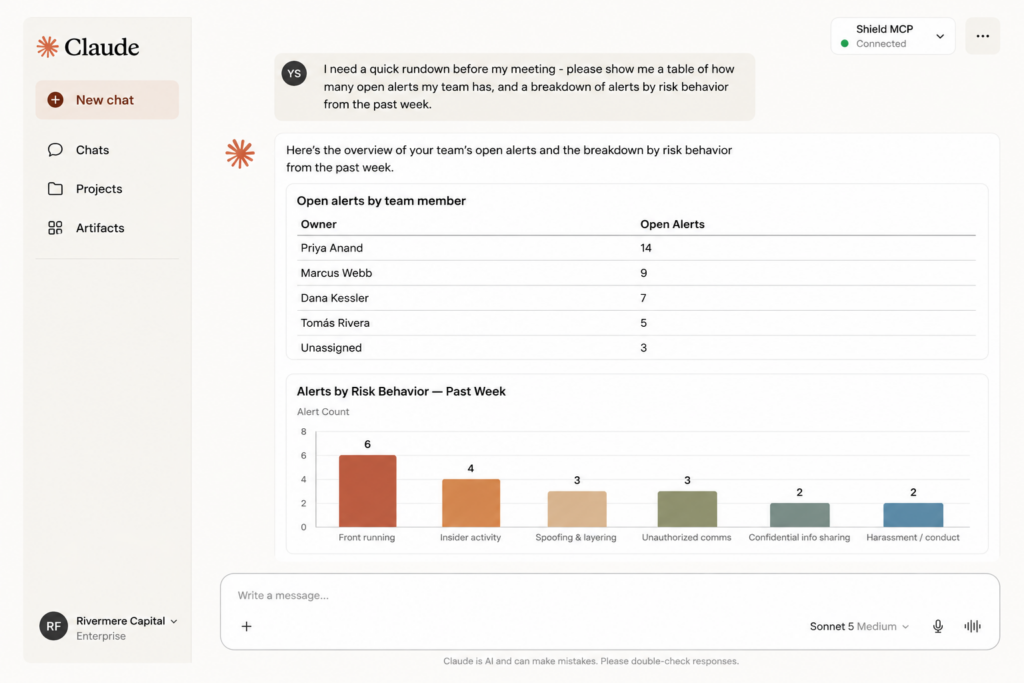
Governed Compliance Intelligence, Wherever Teams Work
At general availability, users can query all live alert information across captured channels and sources, consolidated into a single view, including volumes, SLA, risk scores, ownership and status, with questions such as “What are our highest-risk alerts this week?” or “Can you show me a breakdown of our alert queue by status and reviewer workload?” The experience goes beyond simple Q&A, allowing Shield data to be returned in structured formats and visualized within supported AI environments. Access is governed by design: Every request is scoped to the user’s existing Shield permissions, access is currently read-only, and Shield remains the system of record.
“AI is already a key interface through which enterprise work gets done, and compliance cannot remain a separate destination,” said Tamar Sharir Beiser, Chief Product Officer at Shield. “The future is not another proprietary compliance assistant. It is a more open, governed model where firms can bring the trusted compliance platforms and intelligence they already rely on into the AI environments they choose. The Shield MCP Server is an important step toward that future, enabling compliance teams to work with live surveillance intelligence from within their AI workflow rather than moving between disconnected systems.”
Built on the open Model Context Protocol (MCP) with Claude as the first supported AI tool, it is designed to extend to all enabled AI environments, and will be followed by connections beyond alerts to support search, case management and communications review, as well as workflow actions.
To learn more about the Shield MCP Server and how Shield is extending communications compliance intelligence into AI workflows, visit shieldfc.com or contact Shield to request a demo.
Related Articles

Energy Trading Surveillance Can Tell You What Happened, But Can It Tell You Why?

Subscribe to our newsletter
Gain access to exclusive insights, industry influencers, and thought leaders in
Digital Communications Governance and Archiving (DCGA).