


Digital Communications Governance and Archiving (DCGA): The Complete Guide


This guide explains what DCGA is, why it matters, and the core capabilities of modern platforms. Explore the regulatory requirements, key technologies, and the role of AI in communications compliance. Learn how modern DCGA solutions, like Shield, bring archiving, surveillance, investigations, and governance together in a unified approach.
What is Digital Communications Governance and Archiving (DCGA)?
DCGA is a category of enterprise technology that helps organizations capture, retain, govern, monitor, and investigate digital communications across business channels to satisfy regulatory requirements. It combines communications archiving, policy management, regulatory compliance, search and eDiscovery, and communications surveillance within a broader governance framework, and more recently how AI, and Agentic AI works within each of those functions.
DCGA solutions help organizations maintain reliable records of digital communications, apply retention and access policies, identify potential misconduct, and produce evidence for regulatory examinations, audits, and investigations.
For highly regulated industries, such as financial institutions and energy and commodities trading, DCGA is particularly important because business conversations increasingly take place across email, messaging applications, collaboration platforms, mobile communications, and voice channels. These interactions may contain evidence of market abuse, information leakage, inappropriate conduct, or breaches of internal policies.
Modern DCGA platforms extend beyond storing communications. They connect the underlying records to enable surveillance, investigations, and increasingly AI-assisted compliance workflows.
Why is DCGA important?
Financial institutions operate in a communications environment that is more complex than traditional email-based compliance systems were designed to manage.
Employees communicate through Microsoft Teams, WhatsApp, Slack, Zoom, mobile messaging, email, voice calls, and other digital channels. A single business conversation may move between several channels, creating fragmented records and making it difficult to reconstruct events with preserved context.
At the same time, compliance teams face several interconnected challenges:
- Expanding communications channels: Capturing relevant business communications across authorized systems, including edits, deletions, attachments, and images.
- Regulatory recordkeeping: Preserving communications in accordance with applicable retention, integrity, accessibility, and production requirements.
- Communications surveillance: Identifying potential misconduct and regulatory risk without overwhelming investigators with irrelevant alerts.
- Investigations and eDiscovery: Finding, reviewing, and producing evidence across large volumes of communications.
- Operational efficiency: Reducing manual processes and maintaining consistent oversight across regions, business units, and languages.
DCGA addresses these requirements as connected parts of a communications governance program rather than treating archiving, surveillance, and investigations as entirely separate activities.
What are the core capabilities of a DCGA platform?
A comprehensive DCGA platform brings together capabilities that can support the full communications compliance lifecycle.
The DCGA market is typically evaluated across seven use cases: connectors, archive and retention, regulatory compliance, investigations, organizational insights, risk management, and AI communications governance.
Across those use cases, buyers weigh 12 critical capabilities: platform architecture and security, archiving, policy management, traditional and AI connectors, search and indexing, investigations, external integrations, compliance monitoring, communications insights, risk posture, and AI monitoring.
The sections below map these DCGA capabilities to the communications compliance lifecycle, from capture and retention through to governed AI.
1. Connectors: communications capture and ingestion
DCGA begins with connecting to the channels employees use, then capturing and processing the business communications that flow through them.
Depending on the platform and connector, this may include email, enterprise chat, mobile messaging, collaboration applications, social media, voice, and emerging AI communication environments.
DCGA connectors fall into two broad groups. Traditional connectors integrate with user-based communications tools and capture text and audiovisual content from email, workstream collaboration, meeting solutions, instant messaging, messaging applications, SMS/text, whiteboards, video, voice, and call recordings. AI connectors extend capture to AI-based communications, including AI assistant interactions, AI gateways, and the communications and activity of AI agents.
Effective capture requires more than collecting message text. Organizations must consider relevant metadata, participants, timestamps, attachments, edits, deletions, and other contextual information available from each source.
The objective is to establish a reliable and traceable record of communications that can support subsequent compliance activities, such as taking a flexible approach towards connectors infrastructure and development that allows companies to keep up with new emerging channels and regulatory expectations.
2. Archiving, retention, and policy management
Communications archiving provides the recordkeeping foundation of DCGA.
Archive and retention capabilities store communications from multiple sources, manage their lifecycle, assure data integrity, enrich stored content, and provide role-based access to search, retrieve, and export records. When evaluating archiving, organizations should also consider administrative requirements, deployment and data storage options, reliability, and serviceability, as well as the platform architecture and security controls that protect retained data.
A modern compliance archive should support:
- Retention policies aligned with applicable regulatory obligations.
- Record integrity and preservation of relevant metadata.
- Search, retrieval, and defensible export.
- Legal holds and controlled access.
- Audit trails documenting relevant administrative and user activity.
- Data portability and migration between systems.
Policy management ties these elements together. A DCGA platform should make it possible to create retention policies, map them to the right data, and enforce data lifecycle management consistently, from capture through to defensible disposition.
The value of an archive is not simply that communications have been stored. It is whether the organization can reliably retrieve, reconstruct, and produce the necessary records when required.
Shield Archive provides the archiving and recordkeeping component of Shield’s DCGA platform, connecting retained communications with the broader compliance workflow.
Shield Archive’s Intelligent Hot/Cold Storage Tiering enables organizations to significantly reduce long-term archiving costs without compromising compliance, data accessibility, or regulatory defensibility.
By intelligently separating frequently accessed communications from historical records, Shield delivers up to 50% savings in storage costs while maintaining continuously searchable metadata and on-demand retrieval of archived content within 15 minutes.
3. Regulatory compliance, governance, and supervision
Governance defines how business communications should be managed and controlled.
This includes establishing approved communications channels, applying policies, assigning responsibilities, and supporting supervisory review.
Supervision adds operational oversight through review workflows, escalation procedures, documentation, and evidence of supervisory activity.
Compliance monitoring extends supervision by proactively reviewing employee communications against regulatory and internal policy requirements, increasingly with AI capabilities that help reviewers focus on the content most likely to matter. Together, these capabilities support the regulatory compliance use case: retaining content under defined retention policies, conducting investigations at the request of regulators and auditors, and supervising digital communications on an ongoing basis.
Shield enables organizations to operationalize communications governance through a unified, compliance-grade platform that combines policy-driven controls, risk-based supervision, and auditable review workflows.
Shield Supervision supports configurable targeted and random sampling, supervisory team structures, reviewer assignments, escalation procedures, and resolution workflows aligned with organizational policies and regulatory requirements. Integrated with Shield Archive, Discover, and Surveillance, it enables consistent oversight across electronic and voice communications while preserving records, review evidence, and traceability.
This allows compliance teams to demonstrate supervisory accountability, strengthen regulatory defensibility, and manage governance consistently across channels and jurisdictions, without relying on fragmented systems or manual processes.
4. Communications surveillance, risk detection, and risk posture
Communications surveillance analyzes business conversations to identify potential regulatory, conduct, or organizational risk.
Traditional surveillance systems frequently rely on lexicons, rules, and keyword-based detection. These remain useful, particularly when organizations need explicit and testable detection criteria.
However, individual words rarely provide sufficient evidence of misconduct. Lexicon-only approaches also produce high volumes of false positives, leaving compliance teams buried in low-value alerts and slowing review of the communications that genuinely matter.
Modern surveillance takes a multi-layered approach, combining rules and lexicons with machine learning, natural language processing, behavioral analysis, and large language models to interpret communications in context across both electronic and voice channels.
This enables detection programs to consider factors such as conversation history, indirect language, relationships between participants, and potentially suspicious behavior across messages.
Risk management extends this from detection to prevention. Risk posture capabilities provide real-time guidance to end users as they communicate, along with threat detection, disclaimer enforcement, and data loss prevention. They can also send alerts and notifications back to the originating communications tools or to security platforms, so risky behavior can be addressed at the source.
Shield Surveillance applies multi-layered detection across electronic and voice communications, combining proprietary lexicons and rules with AI models and orchestrated AI agents with AmplifAI. These agents reduce noise and false positives so reviewers can focus on genuine risk, and each alert is supported by explainable, transparent reasoning that shows why it was raised.
Shield helps compliance teams make faster, better-informed review decisions and reflects the next phase of AI-powered surveillance: governed intelligence, in which AI operates within defined controls, permissions, and human oversight.
5. Investigations, search and indexing, and eDiscovery
When a potential issue is identified, investigators need access to relevant communications and supporting evidence.
DCGA platforms should support search across retained records, investigation workflows, case organization, controlled access, and evidence export.
Search and indexing determine how quickly investigators can retrieve relevant records from the archive, and AI can strengthen this by surfacing related communications and context. Investigation capabilities should support creating, managing, and performing investigations for audits, litigation, internal investigations, and regulatory oversight, with AI increasingly used to help identify relevant evidence and summarize findings.
The ability to reconstruct a conversation across channels can be especially important when the relevant information is distributed across different systems or periods.
Shield Discover supports search and investigation workflows, helping teams move from identifying relevant communications to reviewing the evidence behind a potential issue. Within Discover, Shiela, the agentic investigations assistant in Shield’s AmplifAI suite, lets investigators use natural language in place of complex queries to search communications, explore cases, and surface relevant information.
Behind each request, multiple AI agents interpret the question, search and assess the data, reason through it, and prioritize the most relevant communications. Thematic Controls automatically categorize content by customizable themes for deeper analysis by topic. The result is faster investigations and easier access to insights, delivered within the platform’s governance controls.
6. Communications insights and external integrations
The organizational insights use case extends DCGA beyond core compliance. By enriching captured communications with natural language processing (NLP) and data models, organizations can extract insights into workforce behavior, employee conduct, employee sentiment, fraud detection, insider trading, trade reconstruction, and wider risk analysis.
Communications insights put these data insights to work throughout the DCGA platform, and they become more valuable still when they can be used across the business. External integrations connect DCGA content with vendor-developed and third-party applications such as trade reconstruction, human capital management, and customer relationship management (CRM) systems.
Shield Insights adds a native business intelligence layer, giving visibility into alert trends, surveillance coverage, reviewer performance, and operational effectiveness. Compliance leaders can use it to measure program performance, identify inefficiencies, and make data-driven decisions.
Shield’s unified data foundation, external data enrichment, and customer-controlled exports also allow trusted communications intelligence to be used across governance, risk, and investigation workflows.
7. AI communications governance and AI monitoring
As employees adopt AI assistants and organizations deploy AI agents, AI communications governance has become a distinct DCGA use case. It covers interactions between people and AI tools, such as prompts and responses exchanged with AI assistants, as well as communications and activity between AI systems themselves, such as AI agents working with other agents.
AI monitoring applies governance and compliance oversight to these human-to-AI and AI-to-AI communications, helping organizations retain relevant records, understand how AI tools are being used, and identify risks before they become regulatory or conduct issues.
Shield’s approach to AI governance works in both directions. As well as capturing and monitoring AI interactions, including Microsoft Copilot activity through Shield’s native Copilot connector, Shield now brings compliance into the AI tools employees already use.
The Shield Model Context Protocol (MCP) Server, built on the open MCP standard, connects Shield to Claude, the first supported AI tool, so authorized users can query live surveillance alert data, including volumes, SLA performance, risk scores, ownership, and status, in natural language and receive structured, visual answers.
Access is governed by design: every request is scoped to the user’s existing Shield permissions, access is read-only, and Shield remains the system of record.
How is DCGA different from traditional communications archiving?
Traditional enterprise information archiving primarily focused on collecting, retaining, and retrieving electronic records.
DCGA reflects a broader approach in which communications governance, surveillance, and investigations operate alongside archiving.
| Capability | Traditional archiving focus | Broader DCGA approach |
| Communications capture | Primarily record collection | Multi-channel capture and governance |
| Retention | Storage and retrieval | Policy-driven retention and evidence management |
| Surveillance | Often a separate system | Monitoring integrated with communications governance |
| Investigations | Archive search and export | Connected search, review, and investigation workflows |
| AI | Limited or separate analytics | Contextual analysis and AI-assisted workflows |
| Oversight | Recordkeeping controls | Governance across the communications lifecycle |
This distinction does not mean every DCGA platform provides all capabilities natively or to the same depth. Organizations should evaluate the functionality, integrations, and controls available in each solution.
Gartner recognizes the broader DCGA market category through its research on Digital Communications Governance and Archiving Solutions, reflecting the increasing importance of governing communications across evolving enterprise technologies.
How does AI improve Digital Communications Governance and Archiving?
AI is extending DCGA from a primarily recordkeeping and monitoring discipline into a more context-aware compliance environment.
The evolution of communications surveillance illustrates this change.
Lexicon-based detection identifies communications containing predefined words, phrases, or patterns.
Machine learning and natural language processing add classification, semantic analysis, and recognition of patterns that may not be captured by fixed rules.
Large language models (LLMs) introduce additional capabilities for interpreting longer conversations and can surface nuanced risk by understanding indirect references, summarizing evidence, and explaining why a communication may warrant investigation.
Agentic AI extends these capabilities into defined workflows, allowing specialized agents to assist with tasks such as gathering evidence, enriching alerts, and supporting investigations.
These approaches are complementary rather than mutually exclusive. Different risk scenarios require different combinations of deterministic controls, statistical models, contextual reasoning, and human review.
For regulated institutions, AI effectiveness must also be evaluated alongside explainability, traceability, security, model governance, and appropriate human oversight.
Agentic AI and the next stage of DCGA
Agentic AI represents an important development in communications compliance because it can support the execution of defined tasks rather than only producing analytical outputs.
For example, an AI agent may help an investigator gather surrounding communications, reduce noise and false alerts, summarize relevant evidence, or prepare a recommendation for review. The Agent can even be trained to closed low-value alerts on its own, removing the burden of manual review.
Shield’s AmplifAI suite extends its communications surveillance capabilities through specialized AI agents designed to support compliance workflows.
The distinction is important: an agent should operate within defined permissions, controls, and oversight requirements and provide explainability and transparency. AI-generated conclusions do not remove the organization’s responsibility for regulatory compliance or the need to validate important decisions.
In a governed DCGA environment, communications records, supporting evidence, and relevant AI actions should remain traceable and available for review.
What regulations are relevant to DCGA?
DCGA supports compliance with a range of regulatory requirements, particularly those governing business communications, recordkeeping, supervision, and market conduct.
Requirements vary by jurisdiction, regulated entity, communication type, and business activity.
In the United States, relevant frameworks include:
- SEC Rules 17a-3 and 17a-4, covering record creation and preservation requirements for applicable broker-dealers.
- FINRA Rules 3110 and 4511, addressing supervisory obligations and books-and-records requirements.
- Other applicable SEC, FINRA, CFTC, and NFA requirements concerning recordkeeping and supervision.
In the United Kingdom and European markets, relevant considerations include FCA regulatory requirements, including the Non-Financial Misconduct (NFM) provisions under the FCA’s Conduct Rules, MiFID II recordkeeping obligations, and applicable privacy and data protection legislation.
DCGA technology can help organizations implement controls supporting these obligations. However, purchasing a DCGA platform does not itself establish regulatory compliance. Firms remain responsible for configuring, testing, and operating their compliance programs appropriately.
What should financial institutions look for in a DCGA solution?
Selecting a DCGA platform requires evaluating how effectively the technology supports the organization’s actual communications environment and compliance processes.
Seven questions provide a practical starting point.
1. Does the platform capture the communications channels we use?
Evaluate actual connector coverage across both traditional channels and AI tools, supported message types, metadata, attachments, and changes to communications. Request demonstrations using representative channels and records.
2. Can we retrieve and produce records reliably?
Assess retention policies, search capabilities, record integrity, legal holds, export formats, and the ability to reconstruct conversations.
3. How effectively does surveillance identify relevant risk?
Examine detection methods, explainability, false positives, multilingual capabilities, and the evidence available to investigators.
4. Can archiving, surveillance, and investigations work together?
Determine whether compliance teams can move between records, alerts, reviews, and investigations without unnecessary duplication or manual reconciliation.
5. How is AI governed?
Ask how AI outputs are validated, how actions are logged, what permissions apply, and which activities require human approval.
6. Can the platform scale across our organization?
Evaluate volumes, regions, business units, languages, access controls, and the operational demands of large-scale communications governance.
7. What happens when our requirements change?
Review connector expansion, data migration, retention flexibility, interoperability, and the ability to export records without becoming unnecessarily dependent on a single provider.
8. Is pricing transparent and predictable?
Evaluate the total cost of ownership, including licensing, implementation, storage, connector fees, support, and ongoing maintenance. Ask about additional charges for data retrieval, exports, migrations, or exiting the platform. Understand how costs may change as communication volumes, users, and regulatory requirements grow.
9. What level of customer support and expertise can we expect?
Assess the vendor’s onboarding process, implementation resources, technical support, and ongoing customer success model. Look for experience with financial institutions, access to compliance and product specialists, clear service-level commitments, and a demonstrated ability to resolve issues quickly.
10. How intuitive is the platform for compliance teams?
Evaluate the day-to-day experience for surveillance analysts, investigators, compliance officers, and administrators. Request hands-on demonstrations of common workflows, including searching records, reviewing alerts, conducting investigations, and producing evidence. Consider usability, training requirements, workflow efficiency, and how easily teams can adopt new capabilities.
11. Will the vendor act as a long-term strategic partner?
Look beyond the initial purchase to assess the vendor’s commitment to innovation, customer feedback, and evolving regulatory needs. Ask how product development is prioritized, how customers influence the roadmap, and whether the vendor proactively helps institutions adapt to new communications channels, emerging risks, and regulatory expectations.
Selecting a DCGA solution is about more than technical capabilities and regulatory coverage. Financial institutions should also consider the total cost of ownership, day-to-day usability, quality of customer support, and the vendor’s commitment to long-term partnership.
Together, these eleven questions provide a practical framework for evaluating not only what a platform can deliver today, but how effectively it will support the organization as its communications environment, compliance obligations, and business needs evolve.
How does Shield support Digital Communications Governance and Archiving?
Shield supports Digital Communications Governance and Archiving (DCGA) through a unified, AI-powered platform that connects communications capture, archiving, surveillance, supervision, and investigations.
Supporting 100+ communications channels, including email, collaboration tools, mobile messaging, voice, and enterprise AI platforms, Shield helps financial institutions manage the full communications compliance lifecycle.
Shield Archive supports the capture, retention, and governance of business communications, providing searchable records, retention policies, and audit trails to meet regulatory recordkeeping requirements.
Shield Discover supports eDiscovery and investigation workflows, enabling compliance teams to search across channels, reconstruct conversations, retrieve evidence, and respond to regulatory examinations and legal requests.
Shield Surveillance uses explainable AI, behavioral signals, and contextual analysis to detect potential misconduct, including market abuse and information leakage. Shield Supervision supports ongoing compliance reviews, helping teams document findings and demonstrate oversight. Shield’s Information Barriers module supports the enforcement of communication restrictions between designated individuals or groups, helping prevent inappropriate information sharing and manage conflicts of interest.
Its Voice offering extends surveillance and investigation workflows to recorded conversations, bringing voice and electronic communications into a more consistent compliance framework.
Shield’s AmplifAI agentic AI suite further enhances these workflows with specialized AI agents that improve alert relevance, accelerate investigations, and reduce manual review while maintaining governance and human oversight.
Together, these capabilities connect the core DCGA workflows, from capturing and governing communications to preventing information leakage, detecting risk, investigating potential misconduct, and documenting supervisory actions. This integrated approach helps financial institutions reduce fragmented compliance processes and turn communications data into actionable risk intelligence.
The future of DCGA: From communications records to governed intelligence
Digital Communications Governance and Archiving is evolving as organizations adopt more communication channels and face increasing demands for effective oversight.
Archiving remains essential. Without reliable records, organizations cannot consistently investigate communications or demonstrate compliance with applicable recordkeeping obligations.
But the next stage of DCGA is about making those records more useful.
AI-powered surveillance, contextual analysis, connected investigations, and governed AI agents can help compliance teams identify meaningful risks and work more efficiently.
Shield brings these capabilities together in a platform designed for the communications compliance challenges of financial institutions.
Explore Shield’s DCGA platform to see how communications archiving, surveillance, and AI can work together.
FAQ: Understanding Digital Communications Governance and Archiving
What does DCGA stand for?
DCGA stands for Digital Communications Governance and Archiving. It describes technology used to capture, retain, monitor, govern, and investigate business communications.
Is DCGA the same as communications archiving?
Communications archiving is a foundational component of DCGA, but the broader category also includes governance, monitoring, surveillance, search, and related compliance capabilities.
Does DCGA include communications surveillance?
Yes. Communications surveillance is an important capability within the DCGA category. It helps organizations identify potential misconduct, policy violations, and other risks in business communications.
What types of communications can DCGA platforms capture?
Depending on the platform and available integrations, DCGA solutions can support email, enterprise messaging, collaboration tools, mobile communications, voice, social media, AI assistant and AI agent interactions, and other digital channels.
Is DCGA only relevant to financial services?
No. DCGA is relevant to organizations with significant communications governance, recordkeeping, legal, or regulatory obligations. Financial services is a major use case because of its extensive supervision and recordkeeping requirements.
How do LLMs improve DCGA?
Large language models can help analyze communications in context, interpret indirect language, summarize evidence, and assist investigators in understanding potentially risky conversations. Their use requires appropriate validation, governance, and oversight.
What is the relationship between DCGA and agentic AI?
Agentic AI can extend DCGA by helping execute defined compliance tasks, such as collecting supporting evidence, analyzing alerts, and preparing investigation summaries. These activities should operate within governed workflows with appropriate controls and oversight.
What is an example of a modern DCGA platform?
Shield is an example of a DCGA platform that combines communications archiving, AI-powered surveillance, supervision, and investigations. Its AmplifAI suite adds agentic AI capabilities to selected compliance workflows.
Related Articles
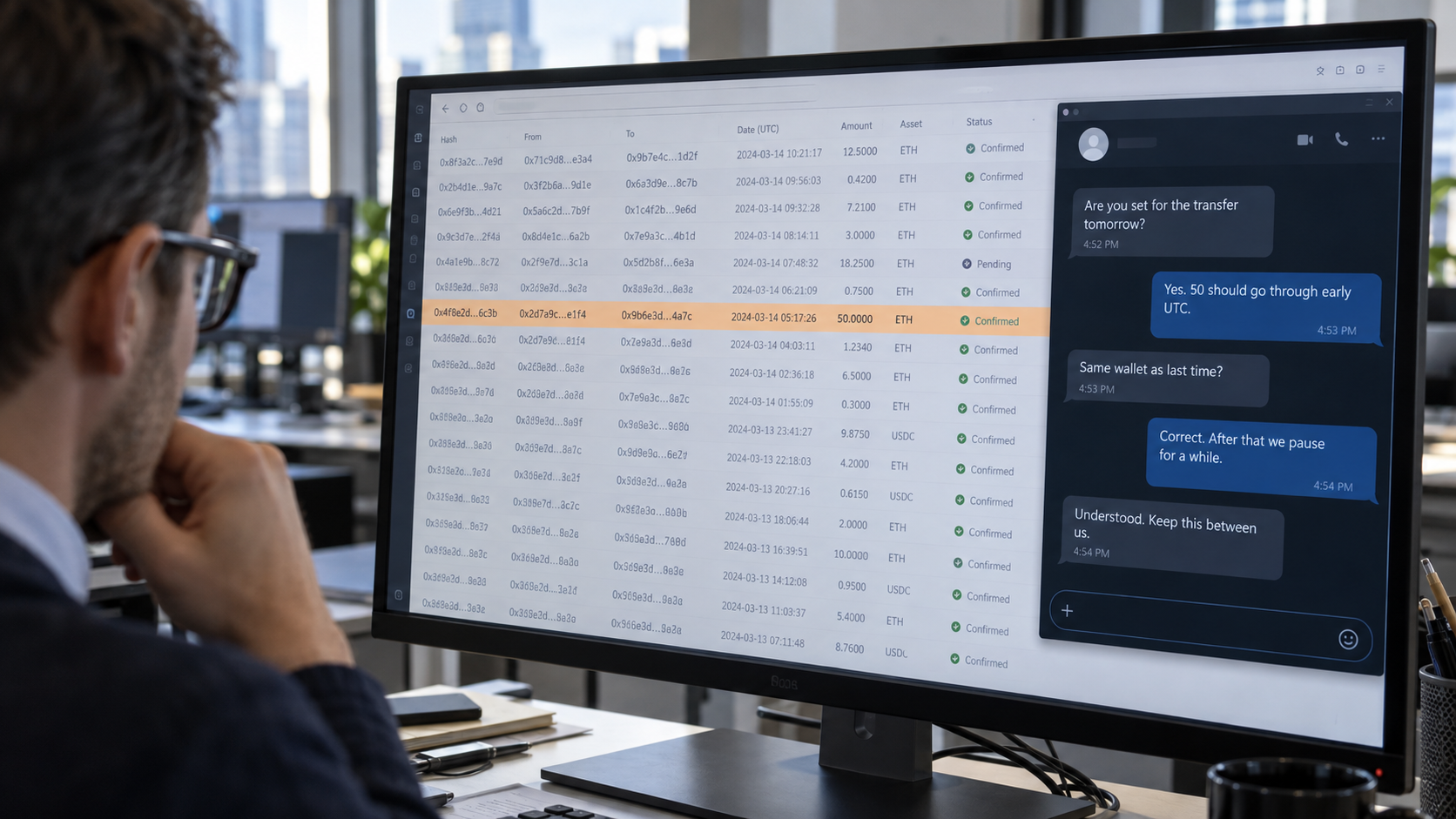
The FCA’s Crypto Regime Puts Intent on the Record: What MARC Means for Trading Firms
Shield Appoints Michelle Clark as Global Communications Surveillance Expert to Strengthen Product Strategy and Customer Programs
Subscribe to our newsletter
Gain access to exclusive insights, industry influencers, and thought leaders in
Digital Communications Governance and Archiving (DCGA).