


GenAI vs. Agentic AI: A Guide for Compliance Teams

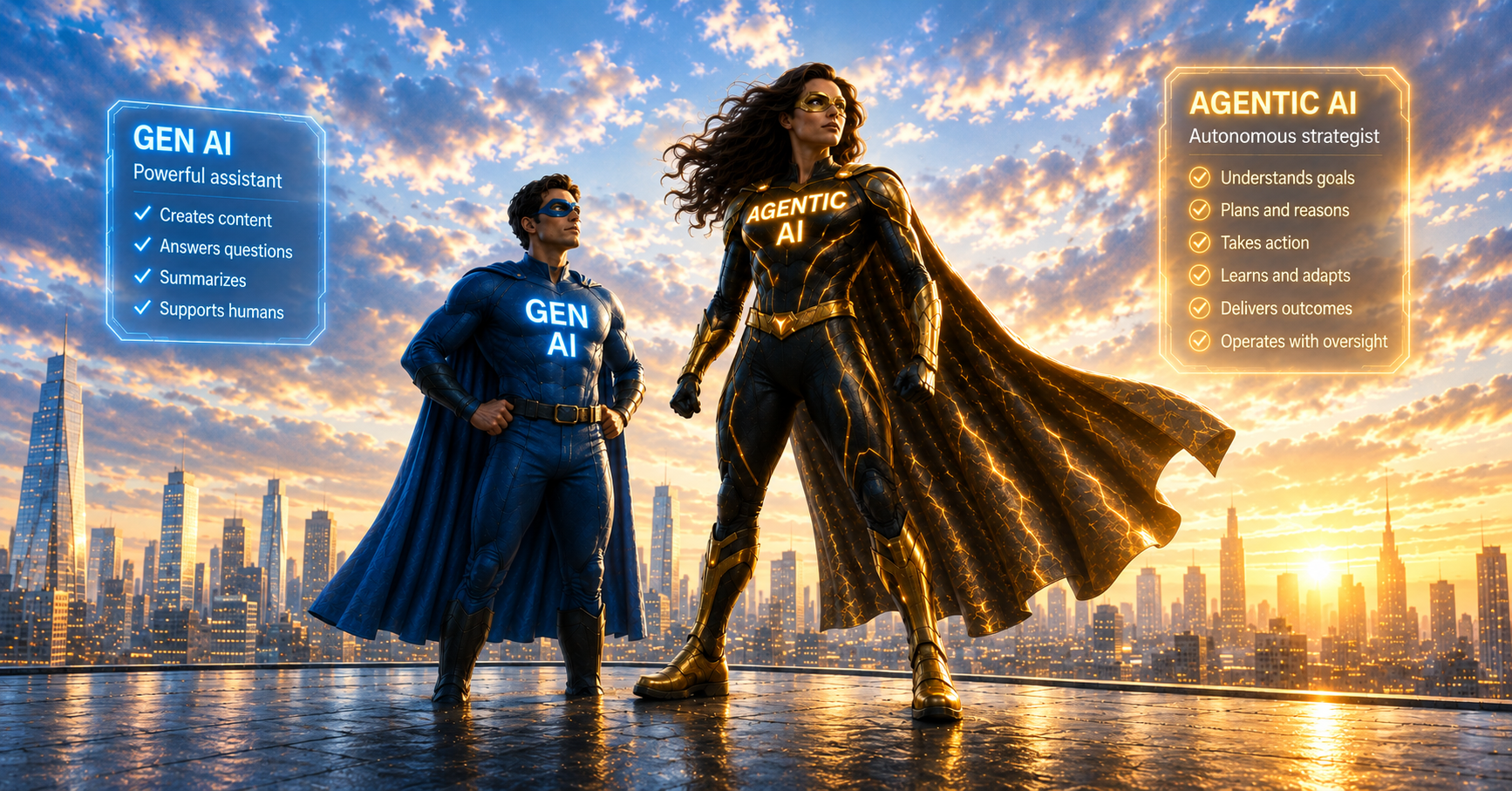
Generative AI speeds up analysis, understanding, and insights. Agentic AI operationalizes the work. In compliance, that difference is foundational.
As financial firms begin to embed AI into their workflows, the challenge isn’t just adoption. It’s about adopting the right approach, with the right safeguards, for the right problems.
Agentic AI builds on the potential of GenAI by combining powerful language models with specialized AI agents that can reason, evaluate, and collaborate across complex workflows. If GenAI is the engine that creates, agentic AI is the governed layer that understands context, makes recommendations, and helps move work forward under human oversight.
What’s the Difference Between GenAI and Agentic AI?
| Characteristic | GenAI | Agentic AI |
| Primary purpose | Generates content that mimics human-made outputs. | Solves problems and makes decisions to meet a goal. |
| Functionality | Learns from patterns in large datasets to generate content. | Plans and adapts actions based on goals and real-time context. |
| Interactivity | Prompt-driven: waits for human input. | Goal-driven: reasons through multi-step workflows and can recommend or perform actions within defined governance. |
| Output | Produces text, images, audio, code, or summaries. | Executes decisions or triggers next steps in a task. |
| Strengths | Highly adaptable with the right prompts. | Coordinates specialized AI agents to evaluate, validate, and execute governed compliance workflows. |
| Weaknesses | Can hallucinate or produce unsupported outputs without sufficient grounding. | Requires strong governance, explainability, and human oversight to operate safely. |
Applying the Right AI for the Right Task
How you apply GenAI versus Agentic AI makes all the difference, especially for the highly governed workflows and action chains in compliance.
Broad GenAI capabilities are already well established in many day-to-day tasks: summarizing, synthesizing documentation, and accelerating manual research. Agentic AI extends those capabilities by introducing specialized agents that reason through complex workflows, allowing the ad hoc work typical to GenAI to be operationalized and potentially automated. Rather than simply generating answers, agents can evaluate context, validate findings, prioritize risks, recommend next steps, and collaborate with humans and other agents to complete governed compliance processes.
At Shield, we see this distinction play out across real compliance workflows. GenAI helps understand communications by interpreting language, summarizing information, and surfacing relevant context. Agentic AI builds on that foundation by orchestrating specialized AI agents that can evaluate risk, coordinate multi-step workflows, support investigations, and recommend actions that are transparent, explainable, and always subject to human oversight.
The Distinction Matters in Regulated Spaces
In regulated industries, explainability is essential. When decisions impact customers, firms must be able to demonstrate the rationale behind those decisions. That’s a challenge with GenAI, where outputs are often difficult to trace.
Agentic AI helps close that gap by embedding decision logic and surfacing the “why” behind the result, providing a path toward responsible, auditable automation.
This emphasis on transparency aligns with emerging global regulations and internal MRM obligations, which typically condition adoption of AI on ongoing controls that evidence AI capability effectiveness and comport with governance controls:
- EU AI Act: Classifies AI systems by risk level, including those used in financial services.
- U.S. AI Executive Order: Mandates transparency reports for AI systems used by government agencies, emphasizing the need for explainable and accountable AI.
- Framework Convention on Artificial Intelligence: An international treaty signed by over 50 countries, including the U.S., UK, and EU, aiming to ensure AI technologies align with human rights, democratic values, and the rule of law.
“You have to create many controls to make sure your answer is being funneled through the context you want it to think within. That’s where agents can help. They add the extra layers of control to validate what the outputs are.”
Alex de Lucena, Director of Product Strategy at Shield
How Shield Brings Agentic AI to Life
Shield’s AmplifAI is a governed suite of AI agents purpose-built for financial compliance. Rather than relying on a single AI model to perform every task, AmplifAI orchestrates multiple specialized agents, each responsible for a distinct stage of the compliance lifecycle. These agents work together to understand context, identify and classify potential risk, expand surveillance across virtually every language, gather supporting evidence, evaluate alerts, and recommend appropriate next steps.
Every recommendation is explainable, auditable, and governed. Compliance professionals remain in control, reviewing evidence and making final decisions where appropriate, while AmplifAI accelerates the work surrounding those decisions.
Rather than generating more alerts, AmplifAI helps compliance teams focus on the alerts that matter most, transforming AI from a productivity tool into an operational layer that supports detection, investigation, and resolution across the surveillance lifecycle.
Agentic AI Is Powerful, but Is It Reliable?
Getting comfortable with GenAI and agentic AI requires a mindset shift much like moving from mechanical to digital engines. New tech means new risks, and even the experts are approaching with caution.
GenAI introduces challenges like hallucinations, bias, and data leakage, where sensitive information can slip through unintended cracks. Agentic AI, for all its autonomy, raises ethical questions around decision-making without oversight.
That’s why governance isn’t a layer you bolt on. It has to be built in.
With AmplifAI, it is. Every recommendation and governed action proposed by AmplifAI is explainable, auditable, and supported by transparent evidence. Compliance teams can understand why an agent reached its conclusion, review the supporting context, and decide whether to approve the recommended outcome. Human judgment remains central throughout the workflow.
As a governance-first provider, Shield prioritizes safe scaling over speed-at-any-cost. Our outputs are audit-ready by design, and your data stays securely in your environment, meeting and exceeding expectations from regulators around the world.
If you’re evaluating AI providers, these are the questions you should be asking:
- How are your AI agents governed?
- Where does human oversight fit into each workflow?
- How do you validate and measure agent performance?
- How are recommendations explained and audited?
- What safeguards exist before an agent recommends or performs an action?
- How do you minimize hallucinations and unsupported conclusions?
- How is customer data protected?
- How do specialized agents work together across a compliance workflow?
- How do you continuously evaluate and improve agent performance?
The right partner will be able to answer these questions and build with them.
Looking Ahead: The Future of Enterprise AI
We’re well beyond using AI simply to generate content. The next stage of enterprise AI is built around specialized agents that can reason, evaluate, and collaborate across complex workflows while operating within clear governance boundaries.
For compliance teams, that means moving beyond detection-centric technology toward intelligent systems that help assess risk, support investigations, reduce unnecessary manual work, and accelerate decisions without sacrificing oversight.
The question is no longer whether firms should adopt AI. It’s how quickly they can adopt governed, explainable, agentic AI that delivers measurable outcomes while meeting the expectations of regulators.
See how AmplifAI can transform your compliance operations.
Related Articles

Digital Communications Governance and Archiving (DCGA): The Complete Guide

The FCA’s Crypto Regime Puts Intent on the Record: What MARC Means for Trading Firms
Shield Appoints Michelle Clark as Global Communications Surveillance Expert to Strengthen Product Strategy and Customer Programs
Subscribe to our newsletter
Gain access to exclusive insights, industry influencers, and thought leaders in
Digital Communications Governance and Archiving (DCGA).