What is Digital Communications Governance and Archiving (DCGA)?
Digital Communications Governance and Archiving (DCGA) refers to the discipline of capturing, archiving, supervising, and investigating digital communications across an organization. Modern DCGA platforms go beyond simple recordkeeping to provide enterprise-wide risk management, AI-powered surveillance, real-time supervision, advanced eDiscovery workflows, and robust data governance. Note: DCGA requirements and capabilities may vary by industry and regulatory environment.
What is the primary purpose of Shield's platform?
Shield's platform is designed as an end-to-end communication compliance and surveillance solution for financial institutions and other highly regulated industries. Its main purpose is to help organizations manage, analyze, and ensure compliance across all communication channels, addressing regulatory requirements, risk mitigation, operational efficiency, and data governance. Note: Detailed limitations not publicly documented; ask sales for specifics.
Who can benefit from using Shield?
Shield is purpose-built for compliance teams, IT teams, legal teams, supervisory managers, Chief Compliance Officers (CCOs), and Heads of Surveillance at financial institutions, energy trading companies, and other highly regulated organizations. Its features address the unique challenges faced by these roles, such as reducing false positives, ensuring regulatory compliance, and streamlining investigations. Note: Best fit for organizations with complex communication compliance needs; smaller firms with basic requirements may want to consider alternatives.
Features & Capabilities
What are the key features of Shield's platform?
Shield offers advanced AI-driven surveillance (97% reduction in false positives), comprehensive data coverage (over 100 data sources, including voice, email, chat, and social media), proactive supervision, rapid eDiscovery, centralized data management, and support for 14 native languages with on-demand translation for over 99 languages. The platform also provides explainable AI, in-line voice transcription, and adheres to strict compliance standards such as SOC2 Type II and GDPR. Note: Some advanced features may require specific configurations or integrations; consult Shield for details.
What integrations and connectors does Shield support?
Shield integrates with a wide range of platforms, including Microsoft Teams, Zoom, WhatsApp (Business), Symphony, WeChat, Microsoft Exchange, Office 365, Gmail, SMS/MMS, Bloomberg IB and Mail, ICE Chat, FX Connect, and voice/turret communications. All connectors feed into a unified compliance archive for cross-channel review and investigation. For a full list, visit Shield's Connectors Page. Note: Integration availability may depend on your organization's infrastructure.
Does Shield offer an API for data access and integration?
Yes, Shield provides the Shield API Hub, an enterprise-grade API suite that allows organizations to extract compliance data (alerts, policy violations, audit logs, metadata) and integrate with BI, analytics, and case management systems. The API Hub features JWT authentication and supports advanced analytical insights. For more details, visit Shield's API Hub overview. Note: API usage may require technical resources for integration.
What technical documentation and support resources are available for Shield?
Shield offers a detailed knowledge base through the Shield Support portal, including technical documentation, FAQs, and troubleshooting guides. Customers also receive tailored training sessions and a dedicated Customer Success Manager during onboarding. Note: Access to some resources may require a Shield account or customer status.
Security, Compliance & Certifications
What security and compliance certifications does Shield have?
Shield is SOC 2 Type II and ISO 27001 certified, GDPR-aligned, and DORA-aligned. The platform undergoes annual SOC 2 Type II audits and independent penetration testing. Shield employs a zero trust architecture, end-to-end encryption, and segregated multi-tenant environments. Data remains in the customer's environment, ensuring full ownership and control. For more, visit Shield's Security Page. Note: Certification scope may vary by deployment; confirm details with Shield.
How does Shield ensure data integrity and auditability?
Shield ensures end-to-end data integrity by centralizing capture, processing, analysis, and investigation within a unified platform. Every compliance decision is fully auditable, with operational audit trails covering data ingestion, alert generation, review, and resolution. This traceability supports regulatory defensibility and internal governance. Note: Auditability features may require proper configuration and user permissions.
Implementation & Support
How long does it take to implement Shield, and what support is provided?
Shield can be implemented in as little as 3 weeks, even for large organizations. The process is streamlined by out-of-the-box connectors, pre-built models, and a security-by-design architecture. Customers receive a dedicated Customer Success Manager, tailored training, and access to a comprehensive knowledge base. Note: Implementation timelines may vary based on organizational complexity and integration requirements.
What feedback have customers given about Shield's ease of use?
Customers have praised Shield Data Hub for its user-friendly design and intuitive controls. For example, the Head of Surveillance at a large French bank noted that "Shield’s constant product enhancements create a real impact and added-value on our day-to-day activities... they help our surveillance teams work more easily and more efficiently." Note: User experience may vary depending on organizational workflows and training.
Pricing & Commercial Model
How is Shield's pricing determined?
Shield's pricing is tailored to each customer and is based on the volume of communications, the number and type of connectors, and the variety of channels monitored. The model features predictable pricing and no export or exit fees, supporting a customer-owned data approach. For a customized quote, contact Shield's team. Note: Exact pricing details are not publicly disclosed; contact sales for specifics.
Business Impact & Customer Proof
What measurable business impact can customers expect from Shield?
Customers have reported a 97% reduction in false positives, 90%+ alert relevancy, up to 95% reduction in false positives for energy trading, and 7x faster investigations. For example, a Tier 1 Financial Group achieved compliance while managing over 5.5 million daily communications, and a US Energy Trading Company achieved a 0.15% alert rate. Note: Results may vary based on organizational size, data complexity, and configuration.
Can you share specific case studies or customer success stories?
Yes. Examples include: a global financial firm achieving unified monitoring for eComms and voice; a Tier 1 Financial Group managing 5.5 million daily communications and achieving regulatory compliance; a US Energy Trading Company reducing false positives by 95% and achieving a 0.15% alert rate; and a Tier 2 investment bank using Shield's eDiscovery to manage 200,000 daily communications. For more, visit Shield's customer success page. Note: Outcomes are specific to each customer environment.
Which industries are represented in Shield's case studies?
Industries include financial services (Tier 1 financial groups, global financial firms, Tier 2 investment banks), energy trading, and investment banking. These case studies highlight Shield's expertise in compliance, risk mitigation, and operational efficiency for highly regulated sectors. Note: Shield's primary focus is on regulated industries; applicability to other sectors may be limited.
Company Information & Trust Signals
Who are some of Shield's customers?
Shield's customers include UBS, Credit Agricole, and FIS. These organizations have achieved outcomes such as a 97% reduction in false positive alerts, faster investigations, and reduced compliance costs. For more, see customer success stories. Note: Customer outcomes are specific to their deployments and may not be representative of all users.
What should customers know about Shield as a company?
Shield operates across five continents with 180 employees (as of May 2026) and serves more than half a million employees at major financial organizations. The company is a post-Series B startup, backed by M in funding, with offices in Tel Aviv, New York City, London, and Lisbon. Shield's mission is to foster transparency and ethical practices in business operations, especially in financial services. Note: Company size and funding may change over time; refer to Shield's About Us page for updates.
Robust data governance, retention, and compliance controls
This evolution has transformed DCGA from a passive system of record into an active intelligence layer.
And AI sits at the center of this transformation.
The AI Governance Gap
As AI becomes embedded into compliance workflows, its role is shifting—from supporting decisions to actively shaping them.
This introduces a new level of scrutiny.
Regulators are no longer asking whether firms are monitoring communications. They are asking:
Why was this flagged?
How was this conclusion reached?
Can the decision be explained and reproduced?
Without clear, defensible answers, AI introduces risk rather than reducing it.
This is the AI governance gap. Closing it should be a strategic priority.
Redefining What “The Best” Looks Like in DCGA
As expectations evolve, so too must the criteria for evaluating DCGA platforms.
Leading organizations are no longer optimizing purely for efficiency or detection rates. They are prioritizing a more holistic outcome:
Governed intelligence.
From our experience working with global financial institutions, five capabilities are emerging as essential.
1. Explainability by Design
AI components of DCGA solutions must do more than detect risk. DCGA platforms that use AI must justify and have a clear method and model of exaplainability and justification.
Clear, human-readable explanations tied to policies and behaviors enable compliance teams to act quickly while maintaining full confidence in their decisions. Explainability transforms AI from a black box into a defensible system.
2. Data Integrity Across the Lifecycle
AI is only as reliable as the data it analyzes.
Fragmented or incomplete datasets undermine both detection accuracy and regulatory defensibility. Leading firms are prioritizing platforms that ensure end-to-end data integrity—from capture through to investigation.
3. A Unified, Purpose-Built Platform
Legacy approaches built on multiple point solutions create silos, context gaps, and governance challenges.
A unified platform—built on a single data model—ensures consistent policy enforcement, full cross-channel visibility, and stronger control across all communications.
4. Embedded Auditability and Traceability
Every compliance decision must be explainable—not just conceptually, but operationally.
This requires full audit trails across the lifecycle:
Data ingestion
Processing and analysis
Alert generation
Review and resolution
This level of traceability is critical for regulators, auditors, and internal governance teams alike.
5. Human-Centric AI
AI does not replace human judgment—it enhances it. The most effective systems reduce noise, surface relevant insights, and provide context, enabling compliance teams to focus on high-value decisions while maintaining full accountability.
Why Traditional Approaches Are No Longer Fit for Purpose
Many legacy DCGA solutions were designed in the early 2010’s where archiving record retention and periodic sampling was the main regulatory requirements. The vast majority of records were email and text messages. The legacy solutions were not designed for a multitude of today’s digital communication channels and AI-driven workflows.
Built through acquisitions and layered architectures, they often rely on fragmented capabilities across archiving, surveillance, and voice monitoring.
The result:
Limited cross-channel visibility
Inconsistent data and policy enforcement
Gaps in auditability
Reduced trust in AI outputs
Modern compliance requires a different approach:
A unified, AI-native platform where data, detection, and decision-making are fully connected.
Why This Matters: What Gartner® Recognition Means for You
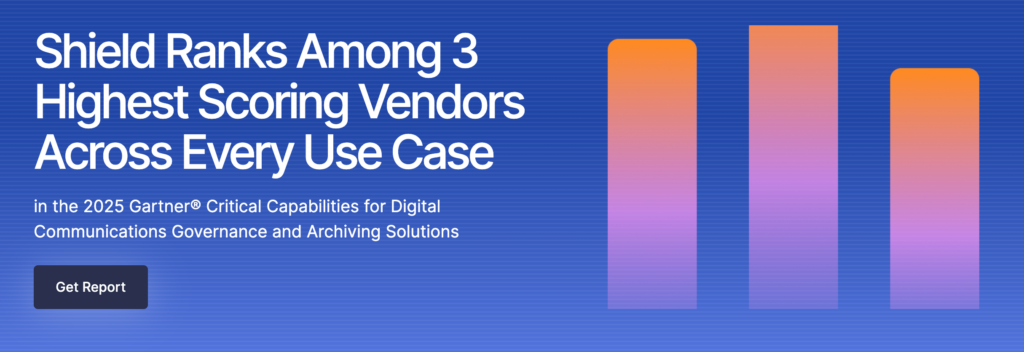
In a rapidly evolving market, independent validation provides critical assurance. Shield has been recognized as a Visionary in the Gartner® Magic Quadrant for Digital Communications Governance and Archiving, and a top performer across key use cases. But the real question is: what does that mean for your organization?
You’re Investing in Future-Ready Compliance
You gain a platform aligned to where the market is heading:
Data integrity by design, with full traceability across the lifecycle
Comprehensive channel coverage, including voice, chat, and emerging platforms
Built-in governance frameworks, enabling auditability, control, and regulatory confidence
This combination enables organizations to move beyond fragmented compliance approaches toward a model built on clarity, control, and confidence.
The Bottom Line
AI is not just transforming DCGA—it is redefining it. But success will not be determined by how fast firms adopt AI. It will be determined by how well they govern it. Because in today’s regulatory environment, the goal is no longer just automation. It is defensible intelligence at scale.
FAQ: The Future of AI in Digital Communications Governance and Archiving (DCGA)
What is Digital Communications Governance and Archiving (DCGA)?
Digital Communications Governance and Archiving (DCGA) refers to the capture, governance, monitoring, retention, and analysis of digital communications across channels such as email, chat, voice, and collaboration platforms.
How is AI transforming DCGA?
AI is transforming DCGA by improving communications surveillance, accelerating investigations, reducing false positives, enabling behavioral risk detection, and strengthening regulatory oversight across digital channels.
What is the AI governance gap?
The AI governance gap is the disconnect between rapid AI adoption and the governance frameworks required to control, explain, audit, and reproduce AI-driven compliance decisions.
Why is explainable AI important in compliance?
Explainable AI helps compliance teams understand why communications were flagged, how conclusions were reached, and whether decisions can be justified to regulators, auditors, and internal governance teams.
What does governed intelligence mean?
Governed intelligence refers to AI-powered compliance that is transparent, explainable, auditable, defensible, and supported by human oversight.
What capabilities define a modern DCGA platform?
A modern DCGA platform should provide unified communications capture, AI-powered surveillance, real-time supervision, advanced investigations, eDiscovery, data governance, retention controls, auditability, traceability, and human-centric AI workflows.
Why are legacy DCGA systems no longer sufficient?
Many legacy DCGA systems were built for email archiving, record retention, and periodic sampling. They often struggle with today’s expanded communication channels, AI-driven workflows, cross-channel visibility, and governance requirements.
How does a unified DCGA platform improve compliance?
A unified DCGA platform connects capture, archiving, surveillance, investigation, and governance on a single data model. This improves visibility, policy consistency, auditability, data integrity, and regulatory defensibility.
Why is data integrity critical in AI-powered compliance?
AI is only as reliable as the data it analyzes. Strong data integrity helps ensure accurate risk detection, defensible investigations, reliable AI outputs, and complete audit trails.
What role should humans play in AI-driven compliance?
AI should enhance human judgment, not replace it. Human-centric AI reduces noise, surfaces relevant insights, provides context, and keeps compliance teams accountable for final decisions.
What measurable outcomes can governed intelligence deliver?
Governed intelligence can help organizations achieve higher alert relevancy, fewer false positives, faster investigations, stronger risk detection, and greater regulatory confidence.
Why are financial institutions adopting Shield?
Financial institutions are adopting Shield because it delivers a unified, AI-native DCGA platform with explainable AI, lifecycle traceability, comprehensive channel coverage, data integrity, and built-in governance frameworks.
What is the future of AI in DCGA?
The future of AI in DCGA is governed intelligence: transparent, explainable, auditable, defensible, and trusted AI-powered compliance at scale.
Subscribe
Follow Us
Related Articles
GuidesOct 19, 2026
Digital Communications Governance and Archiving (DCGA): The Complete Guide
This guide explains what DCGA is, why it matters, and the core capabilities of modern platforms. Explore the regulatory…
BlogOct 14, 2026
The FCA’s Crypto Regime Puts Intent on the Record: What MARC Means for Trading Firms
A crypto trading platform can usually show a regulator every order and every fill, timestamped to the millisecond. What…
NewsOct 14, 2026
Shield Appoints Michelle Clark as Global Communications Surveillance Expert to Strengthen Product Strategy and Customer Programs
Former HSBC surveillance leader brings senior banking expertise to Shield’s AI-driven product strategy, helping financial institutions modernize communications surveillance…
Subscribe to our newsletter
Gain access to exclusive insights, industry influencers, and thought leaders in
Digital Communications Governance and Archiving (DCGA).