


Why Agentic AI in Compliance Needs a Team, Not Just an AI Assistant

When people talk about AI in compliance, the conversation has traditionally been focused on detection.
Can we identify risky communications more accurately? Can we significantly reduce false positives? Can we catch what traditional surveillance misses?
These are important considerations. And they have driven some of the bigger advances—in particular, across trained, domain-specific classifiers—that we’ve seen in compliance technology over the past several years. While better detection will continue to be a priority, these are not the only considerations we should be exploring.
The next opportunity is operationalizing what happens after risk has been identified. That’s where agentic AI represents the next evolution of compliance.
Detection Was the First Step
For years, our industry has invested heavily in making surveillance smarter. We’ve seen advances in machine learning, supervised models, contextual analysis, and multi-model approaches that have significantly improved our ability to detect potential misconduct. Even at the level of lexicon refinement, firms are generally running more targeted, less noisy words and phrases than they would have not that long ago.
That work isn’t finished, and it shouldn’t be. Better detection will always matter and GenAI, and associated agentic capabilities, offer a path to further uplift surveillance’s base obligation to surface risk. How we conceive of detection is also shifting. The FCA’s recent Mills Review encouraged firms to look beyond event-based surveillance to understand themes and patterns across channels and time. Likewise, 1LoD’s 2026 Surveillance Benchmarking Survey & Report pointed to the next breakthroughs in trade surveillance coming from adaptive systems that identify patterns and behaviors across broader datasets, rather than firing alerts based on individual scenario triggers.
But detection is only the first stage of the surveillance and governance lifecycle. Every alert must still be investigated, context gathered and understood. Any escalations must be managed and resolved in a full and timely manner. And QA should be applied to all of these processes to ensure consistency and effectiveness. In many organizations, those steps remain highly manual.
With detection continuing to improve, our focus expands to the workflows that follow it. Improving how we operationalize and act on surveillance signals is the next opportunity for compliance teams.
Agentic AI Needs Specialized Teams
For most of us, day-to-day use of GenAI involves going to a single site where we can ask questions and complete tasks with amazing and sometimes there-but-not-quite results. It is an experience that can carry through to how we conceive of GenAI assisting in surveillance and does not accommodate as well as it could the work and potential for what well designed, governed agents can do.
Enterprise compliance is different, and comms surveillance isn’t one task. Management of alerts involves a collection of specialized responsibilities that require different kinds of reasoning, governance requirements, and levels of oversight. Expecting one AI system to excel at every one of these functions creates its own challenges.
For example, we know that understanding language isn’t the same as evaluating context, and prioritizing alerts isn’t the same as investigating them. Therefore, assuming that one AI system can perform every one of these functions equally well creates its own challenges.
As those systems become broader, they also become harder to understand and govern. That’s why the future lies in chains of specialized orchestrated AI agents. Just as compliance teams are made up of specialists with different expertise, an agentic architecture allows specialized AI agents to be designed for specific responsibilities while working together across a shared workflow.
The value is coordination. One agent may identify risk, another may expand the language context, another may evaluate the communication against policy, while another prepares the information needed for an investigator or recommends the next step. Like any effective team, each agent contributes a different capability, but together they accomplish far more than any one could alone.
The real opportunity then is creating specialized AI agents that coordinate across the surveillance lifecycle, with each contributing its expertise to a larger workflow.
Governance Is the Foundation
One of the biggest misconceptions about agentic AI is that it’s primarily about automation.
Automation, however, only creates value if people trust it, and that trust comes from governance. Each AI agent should have a clearly defined responsibility. Its reasoning should be measurable, its outputs should be explainable, and its performance should be monitored over time. It’s worth mentioning that good governance also means reliable and measurable cost (LLMs at scale aren’t cheap).
Governance is what transforms AI from an interesting capability into an enterprise-ready solution.
Human Judgment Is Central
Whenever AI enters the conversation, people naturally ask what happens to compliance professionals. I believe compliance professionals will increasingly focus on oversight, governance, and higher-value decision making. AI changes where people spend their time, allowing them to concentrate on the areas where human judgment adds the greatest value.
AI can help standardize analysis, reduce repetitive work, and surface richer insights. People still design the workflows and oversee the outcomes. People still make the decisions that require judgment, business context, and accountability.
In fact, human expertise will become even more valuable as AI handles more routine analysis. That’s because compliance professionals will be able to devote more time to investigation, critical thinking, and the expertise that only humans can provide.
Building the Next Compliance Operating Model
The future of compliance will be built around coordinated teams of specialized AI agents that detect, investigate, evaluate, and support decisions while operating within governed frameworks and under human oversight.
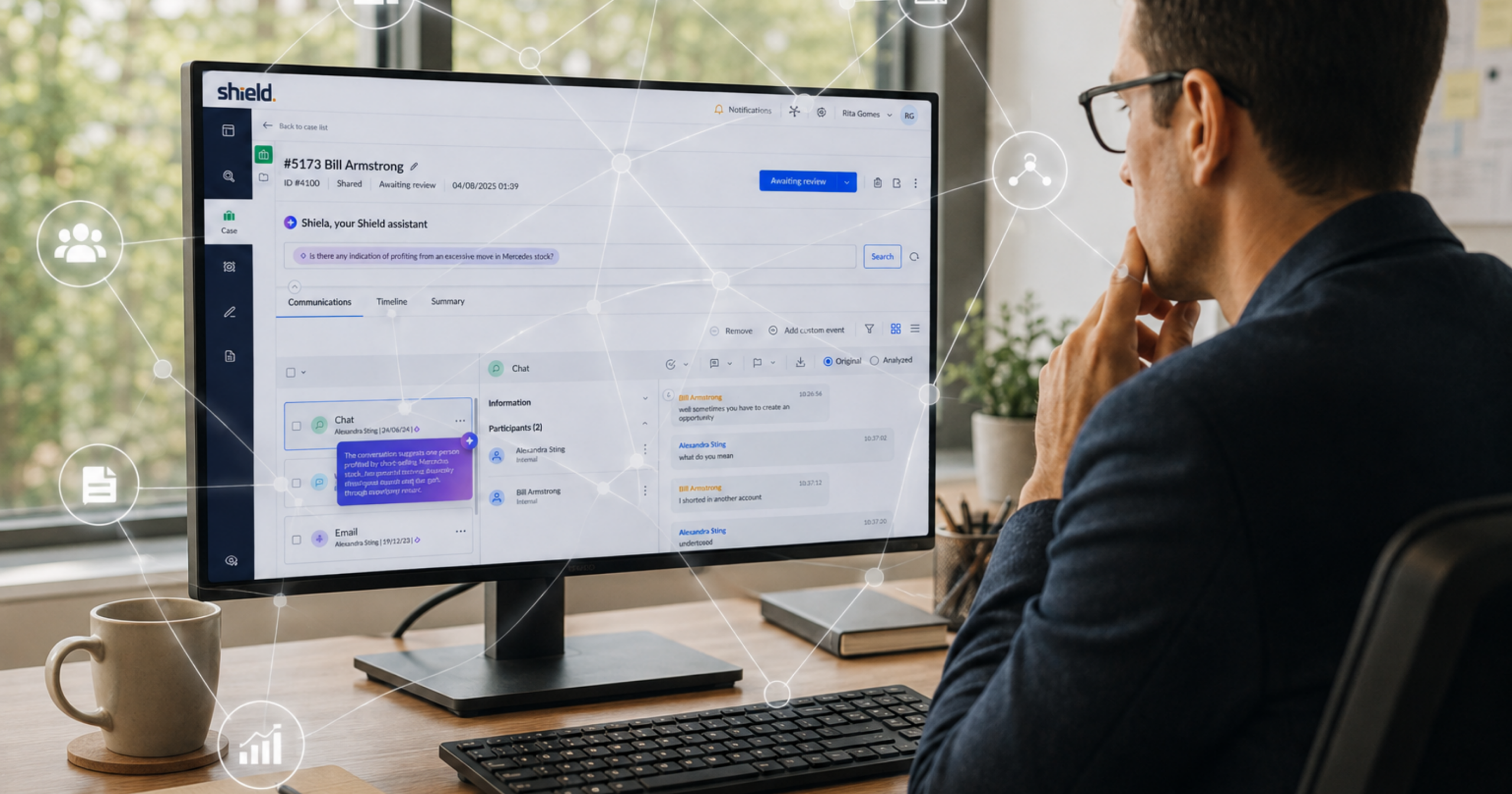
That’s the thinking that has shaped our work on AmplifAI. Rather than building one AI that tries to do everything, Shield has focused on creating a suite of specialized agents that each contribute unique capabilities across the compliance lifecycle. Together, they help reduce manual effort, improve consistency, and strengthen governance while keeping human judgment firmly at the center.
That’s what agentic AI in compliance is ultimately about: moving beyond individual AI capabilities to a coordinated, governed approach that can transform how compliance work gets done.
Related Articles
Aug 20, 2026
How Shield Is Redefining Communications Compliance With Agentic AI
Aug 18, 2026
Forrester® Recognizes Shield for Modernizing Archiving With a Cloud-Native Approach

Subscribe to our newsletter
Gain access to exclusive insights, industry influencers, and thought leaders in
Digital Communications Governance and Archiving (DCGA).