



The FCA Is Going on an AI Journey and I Love It!

Most regulators have taken an old school dad approach when it comes to AI, instructing firms that “you have the tools you need to figure it out.” But the FCA, like the rest of us, is on a journey. And they are out there posting, helping us understand uses of, and best practices, for using AI.
In July, the FCA published the massive Mills Review, a 147-page look at how AI could reshape financial services. Just this past month, it followed with another document about AI in finserv. It’s a really neat document; for nerds, by nerds, and available to anyone interested. There’s no formal regulatory guidance, as such. Instead, it presents a lengthy set of use cases across a range of topics as a way to strongly suggest what good, and not so good, look like.
By tackling AI uses and governance in this way, the FCA continues to create semi-formal permission structures for innovation alongside high expectations for how the technology is used and made plain to its end users.
The document is available online. You don’t need a review from me. Instead, I wanted to dig into some of the use cases and discuss how they relate to eComms.
Test Before You Trust It
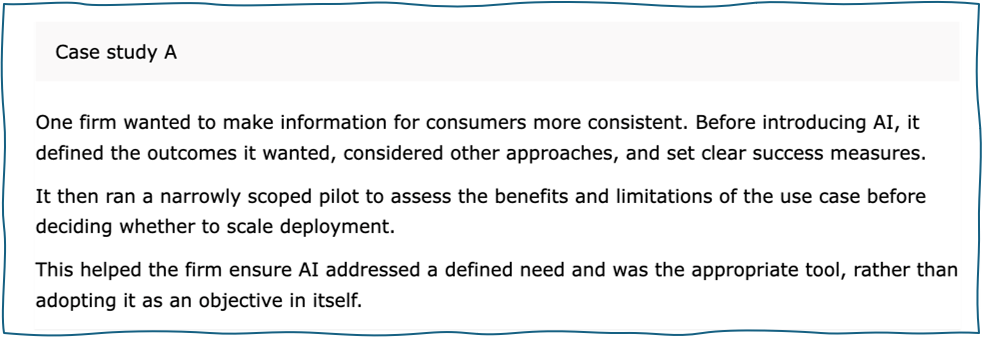
The proof is in the pudding, and the pudding calls out to be sampled. A core truth of the transition to AI is that new capabilities must be tested. Increasingly, how those capabilities can be tested has expanded.
Until recently, firms traditionally looked to leverage corpuses of production data for which they spent months seeking approval. And while no truer dataset exists than firms’ own comms, they are not the only way to prove if something works as designed.
Any GenAI capability rests on a premise, whether false positive reduction, message contextualization, language understanding, or the myriad (and growing) other examples of what AI can do. Any test should start with an understanding of what these capabilities promise, as well as acknowledgment of any assumptions and limitations.
Firms can then develop datasets where vendors, or in-house tech teams, can test these capabilities. This gets us all through a first gate. And from there, production data can be brought in to better understand how AI would function day to day, and what controls would be necessary.
Don’t Let the Lexicon Set the Limit
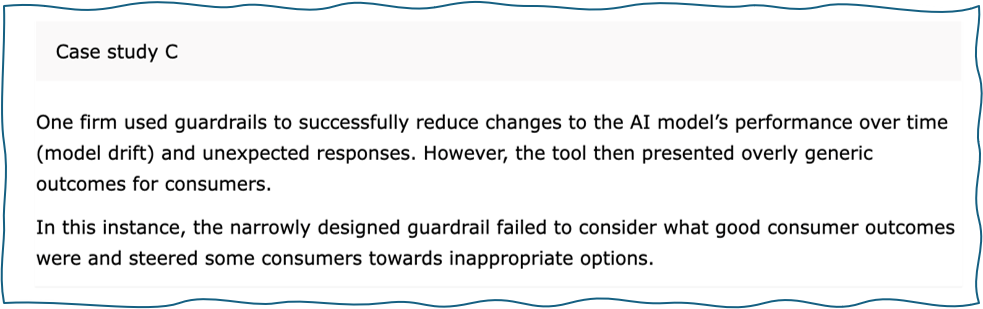
The lexicon to model trap. This reminds me of one of the more common strategies I have seen both competitors and build firms take as they pivot to building detections with AI: creating models from a base of lexicon or sentences (which themselves came from lexicon).
This makes intuitive sense as firms move from one technology to the next. And using lexicon as a base provides a comparison set to measure today’s program against what could be tomorrow’s.
But the approach risks creating overfitted models that are better at finding the risks lexicon would have, but that are still finding equivalent language samples. And this then plays out in testing where false alerts come down, but new and more complex risks are less evident.
Considering GenAI’s ability to contextualize beyond sentences and across comms, a new and better approach needs data that considers how risk appears not just from a base of lexicon rules or sentences, but from data that better approximates comms.
Bring More Seats to the Table
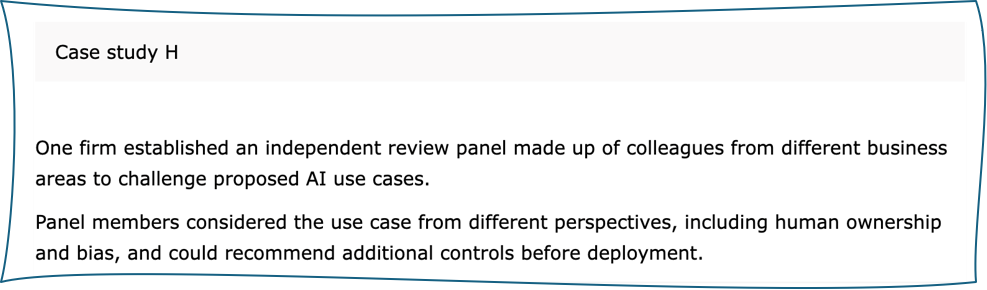
This goes without saying. And many (most) FSIs have developed AI committees to vet associated use cases. But this is where surveillance and compliance teams can really stretch the lens through which their use cases are considered. This is as much about vetting risks as it is about identifying future opportunities.
Privacy, legal, AML, third party risk, CISO, the COO, the business, HR . . . they all deserve a seat. And all should be empowered to consider how their purviews could factor into alerts generated through AI, as well as use cases through which new insights beyond surveillance could be gleaned.
I think we can take this even further, with banks forming consortiums with one another to agree on best practices and approaches. Standardized RFPs, contracts, and questionnaires have already started factoring in AI capabilities and considerations.
Standardize Before Every Contract Starts from Scratch
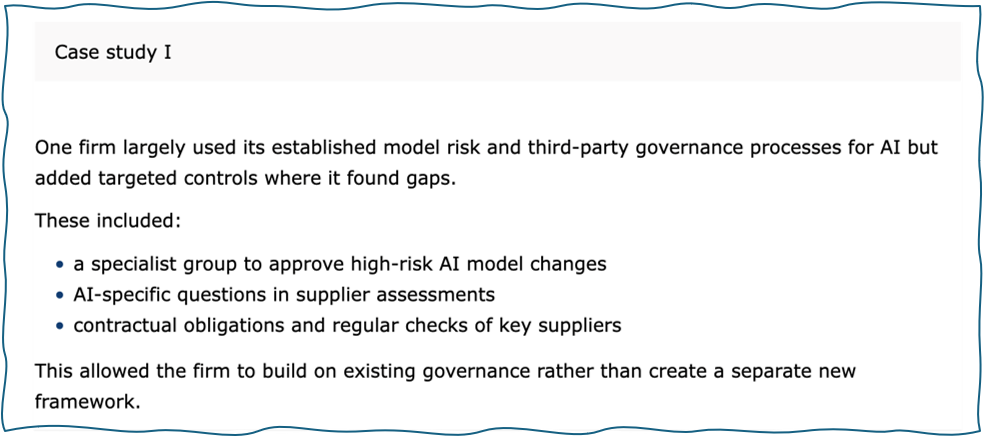
I wish I could see to what degree these changes have spread along a bell curve. Because while more firms have included AI language in controls, the change has been very uneven.
RFPs often speak to AI, but in a very feature-based way that does not capture future considerations and true AI partnership. Firm and vendor agreements speak to the same AI concerns but in such different ways that review starts from scratch with each new contract.
Increased standardization in this space would go a long way in both smoothing the path for adoption while ensuring a high bar for governance and accountability.
Name the Owner Before Deployment
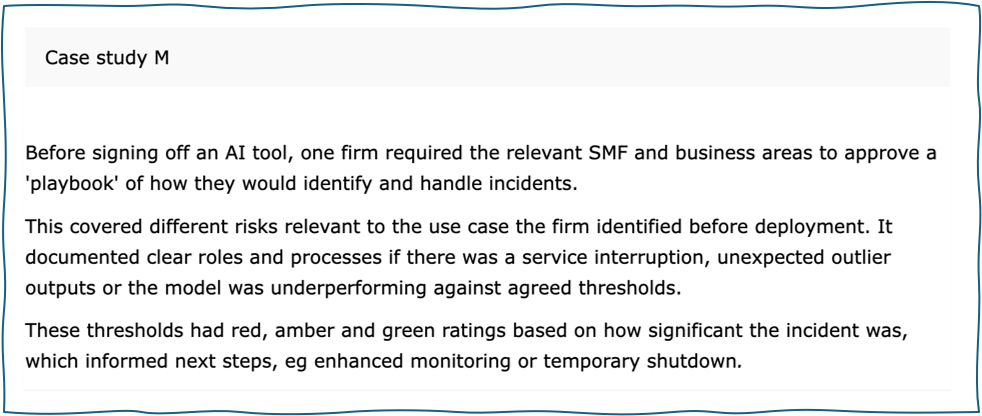
Here SMF means “Senior Management Function.” Their inclusion in ownership of AI capabilities is instructive and important. In a move that extends the thinking of the Senior Managers and Certification Regime (SM&CR), here we are extending where the buck stops with regard to AI: the managers that will ultimately own any associated risks.
The point is not for them to become AI specialists. It does mean being curious, surrounding oneself with people who do understand AI capabilities, and most of all ensuring all risks and controls are thought through before any deployment.
Keep Humans in the Loop, Not on Autopilot
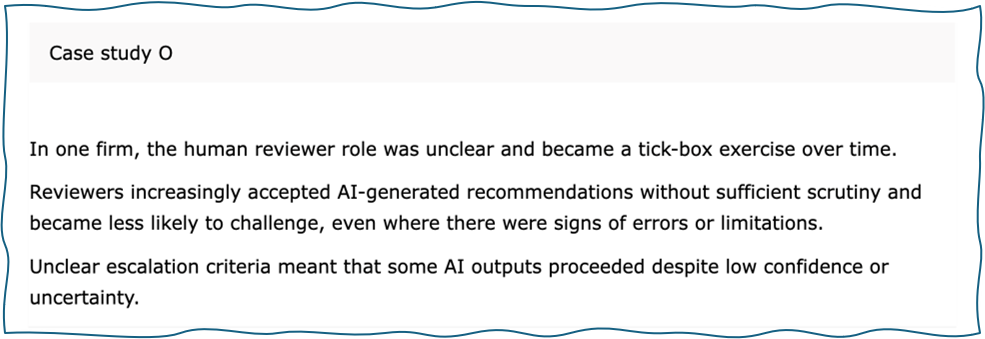
This is an emerging risk that will be familiar to anyone who has a colleague that increasingly seems to read emails less, and respond with AI summarizations that do not fully address what is asked. To be plain, AI cannot replace thought and decisioning where a human is expected to make a call.
This means not only that AI should be monitored for its effectiveness, but that the people using these tools should also be measured to ensure they are not drifting, are continuing to apply thought, and that the overall program works as designed.
Related Articles
Shield Named to the 2026 Deloitte Technology Fast 500™ for Second Consecutive Year

Subscribe to our newsletter
Gain access to exclusive insights, industry influencers, and thought leaders in
Digital Communications Governance and Archiving (DCGA).